Day of the Dead · Explainer
What Is Día de los Muertos, and What Does the Sugar Skull Mean?
Quick answerDía de los Muertos (Day of the Dead) is a Mexican holiday on November 1 and 2 when families remember and honor loved ones who have died. They build home altars called ofrendas with photos, candles, marigolds, food and sugar skulls, and visit and decorate graves. The sugar skull (calavera) stands for a departed person and for the idea that death is part of life.
When is Día de los Muertos?
The main days are November 1 and 2. In many communities November 1 is dedicated to children who have died and November 2 to adults. Families usually begin preparing the altar, the food and the flowers in the last days of October. Customs vary a lot from region to region and from family to family; what follows are the most widely shared traditions.
Where it comes from
Día de Muertos blends Indigenous traditions of honoring the dead, practiced in Mesoamerica long before the Spanish arrived, with the Catholic feasts of All Saints’ Day (November 1) and All Souls’ Day (November 2). The result is a celebration in which death is not hidden or feared, but remembered with food, music, flowers and humor. UNESCO recognizes the Indigenous festivity dedicated to the dead in Mexico as part of the Intangible Cultural Heritage of Humanity.
What goes on an ofrenda (altar)
The ofrenda is the heart of the holiday: a home altar that welcomes the memory of loved ones. Common elements include:
| Element | What it is | Common meaning |
|---|---|---|
| Photos of the departed | Pictures of the people being remembered | Shows whom the altar is for |
| Cempasúchil (marigolds) | Bright orange flowers and petal paths | Color and scent said to guide the spirits home |
| Candles | Lit on the altar and at graves | Light to help find the way |
| Calaveras de azúcar | Decorated sugar skulls, sometimes with names | The departed, and life’s sweetness |
| Pan de muerto | Sweet bread topped with bone shapes | A shared offering for the visitors |
| Favorite food and drink | What the person loved in life | Hospitality for the returning soul |
| Water and salt | A glass of water and a little salt | To refresh and purify after the journey |
| Papel picado | Colorful tissue paper with cut-out designs | Festive decoration, often linked to wind and the fragility of life |
| Copal | Resin incense | Cleanses the space and carries prayers |
What the sugar skull means
A calavera de azúcar is a skull molded from sugar and decorated with colored icing, foil and sometimes feathers. The sugar-molding technique, known as alfeñique, has been practiced in Mexico since colonial times. A skull on the ofrenda stands for a departed person, often with their name written across the forehead. Skulls with the names of living friends are also given as gifts: a playful, affectionate reminder that death is part of life. That spirit of humor is also behind the calaveras literarias, short rhyming poems that “bury” friends, family or public figures in a teasing way.
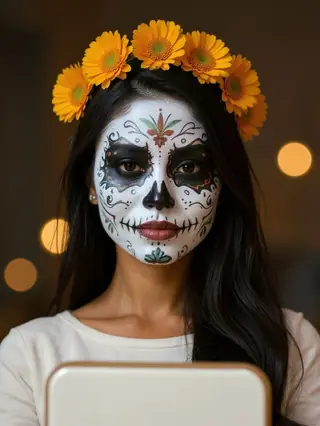
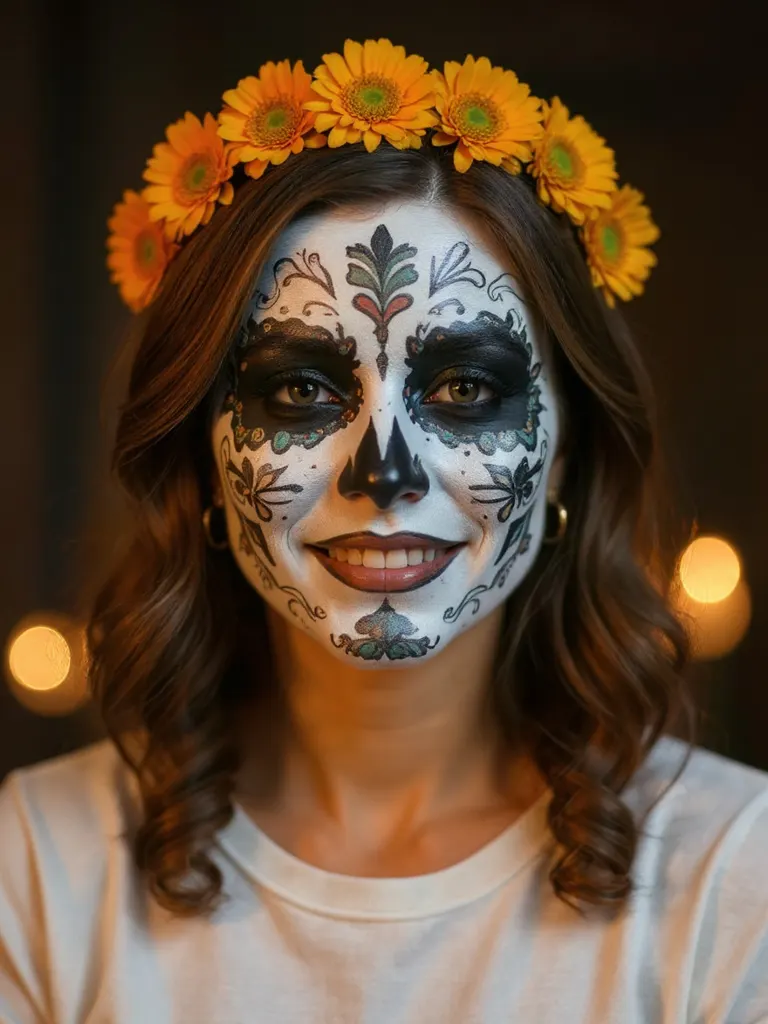
The face paint called “sugar skull makeup” borrows the look of these decorated skulls: a white base, dark eye sockets, a stitched smile and bright flowers. If you want to try it, our sugar skull makeup tutorial walks through it step by step.
Who is La Catrina?
La Catrina is the elegant skeleton lady in a wide hat full of flowers that you see everywhere during the season. She started as a zinc etching by Mexican printmaker José Guadalupe Posada in the early 1900s, a satire of people who tried to look like European aristocrats while denying their own roots; the message was that everyone ends up the same in death. Muralist Diego Rivera later named her “La Catrina” and placed her at the center of his mural Dream of a Sunday Afternoon in the Alameda Central. Today Catrina costumes and makeup are a beloved part of the celebrations.
Día de los Muertos vs. Halloween
| Día de los Muertos | Halloween | |
|---|---|---|
| Dates | November 1–2 | October 31 |
| Roots | Indigenous Mesoamerican traditions and Catholic feasts | Celtic Samhain and the Christian All Hallows’ Eve |
| Spirit | Remembrance and celebration of loved ones | Costumes, scares and fun |
| Main symbols | Ofrendas, marigolds, sugar skulls, La Catrina | Jack-o’-lanterns, costumes, trick-or-treating |
| Where | Homes, cemeteries and town squares | Neighborhoods and parties |
How to take part respectfully
- Learn the meaning before you wear the makeup or decorate: it is a holiday about real people who have died.
- Keep the calavera joyful, not gory or sexualized. Flowers and color are the point.
- Don’t call it “Mexican Halloween.” It is its own celebration.
- Be a good guest. If you visit an altar or a cemetery, ask before taking photos and don’t touch the offerings.
- Remember your own people. Many people outside Mexico set up a small ofrenda with photos of their loved ones; that is in the spirit of the holiday.
A calavera portrait, made with care
Our Sugar Skull style is a respectful calavera face paint with a marigold crown: made for honoring, not mocking. If you’d like to see a sugar skull portrait of yourself, Spooky Portraits creates one from a selfie in about 10 seconds, with a free watermarked preview.
Frequently asked questions
When is Día de los Muertos?
On November 1 and 2. In many places November 1 is dedicated to children who have died and November 2 to adults, and families often begin setting up their altars in late October.
Is Day of the Dead the same as Halloween?
No. They fall close together on the calendar, but Halloween has Celtic and Christian roots and is mostly about costumes and scares, while Día de los Muertos is a family celebration of remembrance with Indigenous and Catholic roots.
What does a sugar skull mean?
A sugar skull (calavera de azúcar) represents a departed soul. Skulls are placed on the ofrenda, often with the person’s name written on the forehead, and are also given to friends as a playful reminder that death is part of life.
Who is La Catrina?
La Catrina is an elegant female skeleton in a wide, flowered hat. She began as an early-20th-century etching by José Guadalupe Posada that poked fun at people who imitated European upper-class fashion; Diego Rivera later gave her the name “La Catrina” and painted her in a famous mural. Today she is a symbol of the holiday.
Is it okay to wear sugar skull makeup if I’m not Mexican?
Sugar skull face paint is common at celebrations in and outside Mexico, and respectful participation is generally welcome. Learn what it means, avoid mocking, gory or sexualized versions, and do not treat it as just another Halloween costume.
Why are marigolds used for Day of the Dead?
Marigolds, called cempasúchil in Mexico, are the traditional flower of the holiday. Their bright color and strong scent are said to help guide spirits back home, so families use them on altars and to make petal paths.